Special Report
Numerous U.S. coastal communities struggle to protect their own land while complying with regulations governing where protective structures can be built. A better understanding of who owns the lakebed and who has the right to choose the design can help with securing these properties.
The Public Building Commission and Chicago Department of Transportation (CDOT) have published a 2026 feasibility study for the Lake Michigan shoreline between 71st and 75th streets. While these documents do not provide a final design, they offer a clearer answer to lakebed ownership in Chicago and the CDOT right-of-way.
What the shoreline erosion control study includes
The feasibility study has had several drafts during the early part of the year to assess broader shoreline work. In it, experts analyze Lake Michigan shoreline erosion to identify possible improvements between 71st and 75th streets. As it stands, the shoreline is highly vulnerable to natural forces, such as persistent waves and storms.
Existing shoreline conditions are cataloged first to gauge the damage. Erosion near rivers or coastlines creates the risk of foundation exposure or slope instability, according to GeoStabilization International, a geohazard mitigation firm.
Understanding these current site conditions makes it simpler to evaluate the feasible shoreline protection options for lakefront property owners. Currently, only temporary and aging measures offer limited protection from erosion and water damage.
The feasibility study also offers clarity on the relatively unusual ownership pattern along the Lake Michigan shoreline, acknowledging that the project site includes CDOT right-of-way, private parcels and Chicago Park District (CPkD) property.
“Submerged land within the project area was originally granted to the South Park Commissioners by the State of Illinois under legislation enacted in 1903,” the study reveals. “These rights were transferred to CPkD following the consolidation of the park district system in 1934. As a result, CPkD retains ownership of the lakebed beyond the former Lake Park Avenue right-of-way.”
It adds that the approximately 150-foot-wide Lake Park Avenue right-of-way remains under CDOT jurisdiction. The right-of-way also extends into the lake where the road once existed.
Clarifying lakebed ownership in Chicago
The study treats CPkD-owned lakebed areas as a key ownership constraint when evaluating where shoreline protection concepts could be located. Thus, there are limited ground rules as to the shoreline stabilization improvements that can be made for private spaces.
For reference, just across Lake Michigan, Michigan is a cheap state for buying lakefront property and has differing shoreline boundaries since private right-of-way is possible. The difference in complexity between projects on the Chicago and Michigan sides may become evident in the long run.
While shoreline improvements must be located on public property to secure federal funding, engineers can still evaluate improvements while accounting for site-specific conditions. Here are possible shoreline stabilization methods that can help protect Chicago’s coastal communities and shoreline.
1. Utilize hard armoring methods
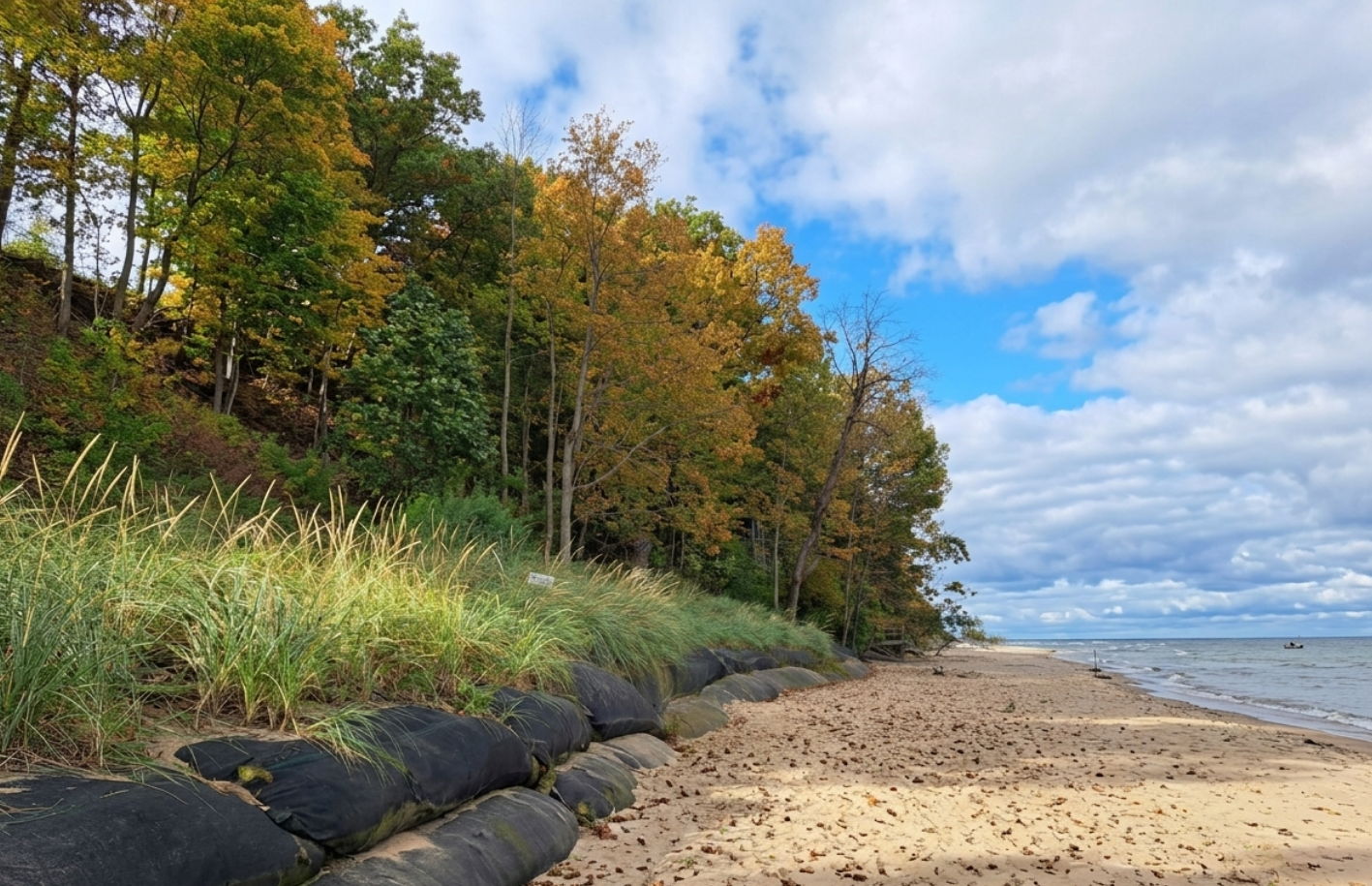
Shoreline armoring structures are commonly used to protect all kinds of infrastructure in coastal communities and prevent sediment loss
Riprap is a popular option, especially for sloped banks, since it can absorb and scatter wave energy. Breakwaters and seawalls can also help stop the wave energy from entering. Plus, their verticality can help minimize space usage.
GeoStabilization International also notes that launched fiberglass soil nails can be used in corrosive environments for stabilization. “Launched nails can be perforated to act as drains or pressure grouted with cementitious or non-cementitious materials to improve soil properties in the nail zone,” it shares.
2. Explore eco-friendly traps
It’s vital to find a balance between stabilizing shorelines for properties and preserving the ecosystem that inhabits that space. Incorporating natural features into shoreline stabilization designs can create adequate and self-sustaining coastal defense while even restoring critical habitats for plants and animals.
For example, bioengineered knitted mesh systems can help mitigate wave energy rather than reflect it, without disturbing the vegetation beneath. It can even allow the vegetation to root through the system.
3. Take a combined approach
Companies don’t have to choose between softer or harder shoreline stabilization methods. For instance, a project that met the Waterfront Edge Design Guidelines’ gold standards includes elements below and above water habitats and breakwaters. It can improve resilience against severe erosion without sacrificing the native flora and fauna in the area.
Shoreline erosion control as an industry was estimated at $3.84 billion in 2025 and is projected to reach $6.5 billion by 2035.
Prioritize shoreline protection
Lakebed ownership may not fall on private property, but construction companies can still explore and implement protections for these public assets when necessary. Perform lakefront repairs with compliance and knowledge to sustainably secure shorelines.